
How .NET 8 Minimal APIs Helped PIT Solutions Replace Bloated Controllers
At a Glance
PIT Solutions slashed boilerplate, cut development time by 3×, and simplified microservices by migrating to .NET 8 Minimal APIs. Here’s how we did it—and the best-practice tips for you
The Challenge: Controller Overhead in Microservices
At PIT Solutions, we constantly strive to streamline our microservice architecture. Over time, we observed a recurring inefficiency: many microservices were over-engineered. Even simple endpoints—like dropdowns, health checks, or country lists were scaffolded using the full controller-service-repository model. This caused:
- Unnecessary complexity for trivial APIs
- Longer development and deployment cycles
- Steep onboarding curves for junior developers
- Reduced flexibility in rapidly iterating internal tools
We needed a lightweight, efficient alternative that didn’t sacrifice testability or maintainability.
Our Solution: Minimal APIs in .NET 8
Introduced in .NET 6 and fully matured in .NET 8, Minimal APIs offer a streamlined programming model. They allow you to define HTTP endpoints directly within Program.cs, eliminating the need for controller classes.
Minimal APIs in .NET 8 were the perfect fit for our use cases:
- Internal utility services
- Microservice endpoints
- Lightweight, read-only APIs (e.g., dropdowns)
- Prototypes and MVPs
Use Case: Lightweight Lookup APIs
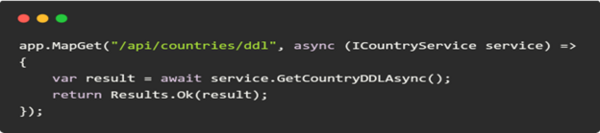
We maintained multiple lookup endpoints—for countries, departments, insurance providers, etc.—each with a near-identical controller setup. It was excessive. With .NET 8 Minimal APIs, these were reduced to a single, readable line:
Key Benefits of Minimal APIs
.NET 8 Minimal APIs significantly improved our efficiency:
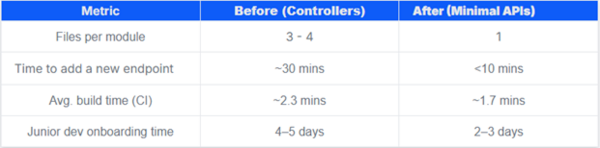
Beyond these, we gained:
- Cleaner code and architecture
- Faster iterations and deployment
- Simplified service and route management
Best Practices for Minimal APIs
To ensure maintainability, we followed several best practices:
- Keep business logic in services, not endpoints.
- Use extension methods for organizing routes.
- Implement centralized exception handling.
- Integrate Swagger with XML documentation for better visibility.
Example: Secure Endpoint

API Versioning

When to Use Minimal APIs
Ideal For:
– Internal admin portals
– Utility or support services
– MVPs or PoCs
– Public read-only APIs
Avoid If:
– Complex REST APIs with multiple filters, inheritance, or conventions
– Applications relying on attributes, filters, or MVC routing.
Final Thoughts from PIT Solutions
.NET 8 Minimal APIs are a momentous change for building microservices in .NET. They offer:
- A powerful, readable, and clean syntax
- Full support for DI, validation, and authentication
- Real-world speed gains in both development and deployment
At PIT Solutions, our developer productivity improved by over 3× after adopting Minimal APIs. For anyone looking to simplify microservices, reduce overhead, and speed up delivery — we highly recommend exploring this approach.
🔗 Explore Microsoft’s Minimal API Documentation
📩 Need help implementing Minimal APIs or secure authentication flows? Contact us at PIT Solutions — we would love to support your transformation journey.